Secondary nav 2022

  • Equipment
  • Software
  • Training

Main navigation 2022

  • About
    • About HR Wallingford
    • Our leadership
    • Our people
    • Our impact
      • Annual report & financial statements
      • Gender pay
      • Social impact
      • Sustainability
    • Our story
    • News
    • Insight articles
    • Policies
  • Projects
  • Expertise
    • Coastal & marine sustainability
      • Coastal hazards & resilience
      • Coastal morphology & sediment dynamics
      • Dredging and sediment management
      • Marine & coastal environment
      • Ports, harbours and shipping
      • Subsea engineering
      • Waterfronts, marinas and resorts
    • Energy transition
      • Fixed offshore wind
      • Floating offshore wind
      • Liquified gas & transition fuels
      • Nuclear
      • Wave, tidal, solar & hydropower
    • Water & climate resilience
      • Dams & reservoirs
      • Freshwater environment
      • Integrated flood management
      • Surface water systems
      • Water management for climate resilient development
      • Water supply & drought resilience
  • Facilities
    • Explore our facilities
    • Ship simulation
      • Australia Ship Simulation Centre
      • UK Ship Simulation Centre
    • Physical modelling
      • Fast Flow Facility
      • Tsunami simulator
      • Volumetric flow flume
      • Wave basins
      • Wave flumes
      • Erosion rate measurement
      • Water rescue training
  • Careers
    • Careers overview
    • Working at HR Wallingford
    • Job opportunities
  • Contact
  • About
    • About HR Wallingford
    • Our leadership
    • Our people
    • Our impact
      • Annual report & financial statements
      • Gender pay
      • Social impact
      • Sustainability
    • Our story
    • News
    • Insight articles
    • Policies
  • Projects
  • Expertise
    • Coastal & marine sustainability
      • Coastal hazards & resilience
      • Coastal morphology & sediment dynamics
      • Dredging and sediment management
      • Marine & coastal environment
      • Ports, harbours and shipping
      • Subsea engineering
      • Waterfronts, marinas and resorts
    • Energy transition
      • Fixed offshore wind
      • Floating offshore wind
      • Liquified gas & transition fuels
      • Nuclear
      • Wave, tidal, solar & hydropower
    • Water & climate resilience
      • Dams & reservoirs
      • Freshwater environment
      • Integrated flood management
      • Surface water systems
      • Water management for climate resilient development
      • Water supply & drought resilience
  • Facilities
    • Explore our facilities
    • Ship simulation
      • Australia Ship Simulation Centre
      • UK Ship Simulation Centre
    • Physical modelling
      • Fast Flow Facility
      • Tsunami simulator
      • Volumetric flow flume
      • Wave basins
      • Wave flumes
      • Erosion rate measurement
      • Water rescue training
  • Careers
    • Careers overview
    • Working at HR Wallingford
    • Job opportunities
  • Contact
  1. Home >
  2. Expertise >
  3. Energy transition >
  4. Floating offshore wind

Floating offshore wind

Share
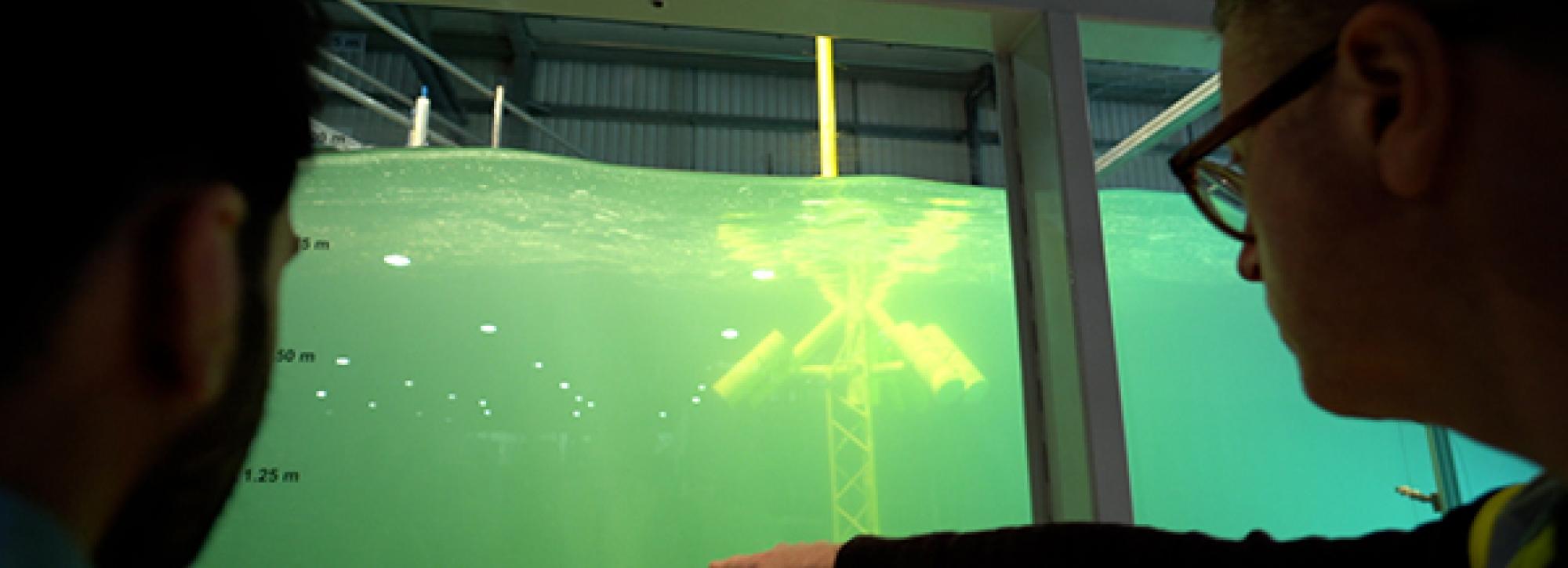
View of the Stinger Keel model in HR Wallingford's Fast Flow Facility

Reducing floating wind risk with advanced modelling, engineering and real‑world testing.

Floating offshore turbines access stronger winds in deeper waters but introduce new engineering and operational challenges. We combine physical and numerical modelling, metocean forecasting, engineering and simulation to de‑risk design, deployment and performance. We are planning the UK's first proposed deep‑water testing facility, strengthening national capability for FLOW innovation, validation and certification.

Why floating offshore wind is growing

Countries are planning to scale up floating offshore wind to reach net‑zero targets where deeper waters rule out fixed foundations. Further offshore, winds are stronger and more consistent, improving energy yield. The UK aims for in excess of 30 GW offshore wind ambition.

Engineering and environmental challenges in floating offshore wind

As floating wind expands, developers must balance platform stability with harsher wind‑wave conditions, design moorings and anchors for varied seabeds, manage fatigue in structures, risers and rope moorings, and plan safe towing and wet‑storage operations. Cable failure, seabed interaction, and port capacity constraints remain major risks. Many ports require significant enhancement to accommodate large‑scale floating turbine assembly and marshalling. With limited large‑scale testing facilities and growing environmental expectations, it is vital to reduce uncertainty early.

How HR Wallingford reduces risk across floating wind projects

We integrate physical modelling with advanced numerical analysis to optimise hydrodynamics, mooring design, and dynamic cable systems. High‑resolution metocean and response‑based forecasts guide safe design, construction and operation while our engineering and navigation teams support assembly and installation planning, scour protection and cable systems. Our underwater noise tools also support strong, evidence‑based environmental assessments.

UK deep‑water testing facility for floating offshore wind

HR Wallingford is helping shape the UK’s first proposed national deep‑water testing facility for floating offshore wind. With early design funded through The Crown Estate’s Supply Chain Accelerator, the 40 m × 40 m × 6 m tank will enable certification‑grade physical testing of floating platforms, moorings and dynamic cables under multi‑directional waves, offering validation beyond numerical modelling and accelerating safe commercial deployment. 
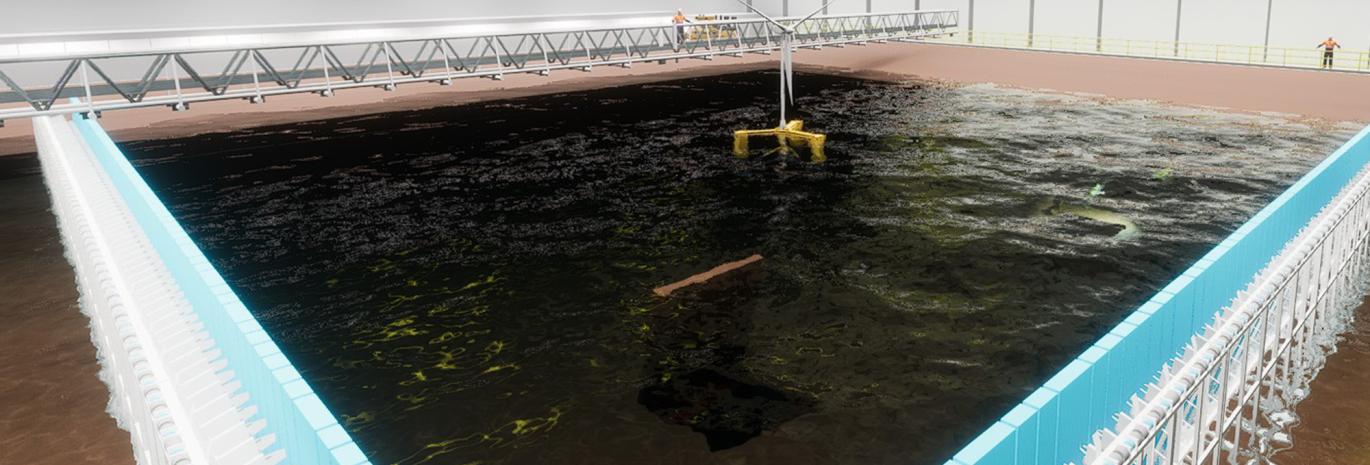
View of our Deep water tank in project

Impact of our floating offshore wind support

Our integrated approach reduces design uncertainty, improves safety, cuts weather downtime and supports robust consenting. Ports, developers and regulators benefit from clearer planning, better risk reduction and improved operational confidence, delivering cleaner, more reliable energy for communities. 

Floating offshore wind expertise

Physical modelling of floating platforms

Scale testing of platform motions, wave loading and mooring behaviour in large basins to validate and de risk designs.  

Mooring and anchor optimisation

Design and assessment of catenary and shared mooring systems to balance footprint, reliability and cost.  

Dynamic cable engineering

Modelling and protection strategies for inter array and export cables, including fatigue and stabilisation. 

Fatigue analysis of floating wind structures

Assessment of fatigue life for substructures, moorings and cables under continuous wind wave loading to extend asset life and improve safety.

Metocean analysis and forecasting

High resolution wind, wave, water level and current modelling with response based forecasts for construction and O&M.

Port masterplanning for FLOW

Capacity studies, navigation simulation and planning for assembly, marshalling, wet storage and tow out.

Underwater noise modelling

Noise propagation and satellite enhanced background mapping to support environmental assessments.  
 

Seabed processes and scour

Assessment of sediment mobility and scour to inform foundation, anchor and cable protection design.

Navigation and towing risk

Simulation based studies to define safe weather limits, routes and operational envelopes for tow out and maintenance. 

Environmental assessment support

Evidence led studies to support consenting and biodiversity outcomes.

Large scale testing facility development

Technical leadership shaping the UK’s proposed deep water test facility for certification grade FLOW trials.

Get in touch

Iain Gunn
Sector Lead – Energy
Contact Profile

Explore more

  • All
  • Project
  • Expertise
  • News
  • Insight
  • Facility

Fixed offshore wind

Screenshot of wave modelling in Telemac with orange, yellow and blue colours

Wave, tidal, solar & hydro power

Numerical modelling output for scour at an offshore wind farm cable

Subsea engineering

Offshore wind

We are global leaders and independent experts in how to live and work sustainably with water

Social media

  • BlueSky
  • LinkedIn
  • YouTube

Expertise

  • Coastal & marine
  • Energy transition
  • Water & climate
  • Software solutions
  • Equipment & technology

Company

  • About
  • Careers
  • News
  • Insights
  • Sustainability

Legal

  • Privacy & data protection
  • Policies
  • Modern slavery statement
  • Terms & conditions
  • Sitemap
© 2026 HR Wallingford
Contact