Secondary nav 2022

  • Equipment
  • Software
  • Training

Main navigation 2022

  • About
    • About HR Wallingford
    • Our leadership
    • Our people
    • Our impact
      • Annual report & financial statements
      • Gender pay
      • Social impact
      • Sustainability
    • Our story
    • News
    • Insight articles
    • Policies
  • Projects
  • Expertise
    • Coastal & marine sustainability
      • Coastal hazards & resilience
      • Coastal morphology & sediment dynamics
      • Dredging and sediment management
      • Marine & coastal environment
      • Ports, harbours and shipping
      • Subsea engineering
      • Waterfronts, marinas and resorts
    • Energy transition
      • Fixed offshore wind
      • Floating offshore wind
      • Liquified gas & transition fuels
      • Nuclear
      • Wave, tidal, solar & hydropower
    • Water & climate resilience
      • Dams & reservoirs
      • Freshwater environment
      • Integrated flood management
      • Surface water systems
      • Water management for climate resilient development
      • Water supply & drought resilience
  • Facilities
    • Explore our facilities
    • Ship simulation
      • Australia Ship Simulation Centre
      • UK Ship Simulation Centre
    • Physical modelling
      • Fast Flow Facility
      • Tsunami simulator
      • Volumetric flow flume
      • Wave basins
      • Wave flumes
      • Erosion rate measurement
      • Water rescue training
  • Careers
    • Careers overview
    • Working at HR Wallingford
    • Job opportunities
  • Contact
  • About
    • About HR Wallingford
    • Our leadership
    • Our people
    • Our impact
      • Annual report & financial statements
      • Gender pay
      • Social impact
      • Sustainability
    • Our story
    • News
    • Insight articles
    • Policies
  • Projects
  • Expertise
    • Coastal & marine sustainability
      • Coastal hazards & resilience
      • Coastal morphology & sediment dynamics
      • Dredging and sediment management
      • Marine & coastal environment
      • Ports, harbours and shipping
      • Subsea engineering
      • Waterfronts, marinas and resorts
    • Energy transition
      • Fixed offshore wind
      • Floating offshore wind
      • Liquified gas & transition fuels
      • Nuclear
      • Wave, tidal, solar & hydropower
    • Water & climate resilience
      • Dams & reservoirs
      • Freshwater environment
      • Integrated flood management
      • Surface water systems
      • Water management for climate resilient development
      • Water supply & drought resilience
  • Facilities
    • Explore our facilities
    • Ship simulation
      • Australia Ship Simulation Centre
      • UK Ship Simulation Centre
    • Physical modelling
      • Fast Flow Facility
      • Tsunami simulator
      • Volumetric flow flume
      • Wave basins
      • Wave flumes
      • Erosion rate measurement
      • Water rescue training
  • Careers
    • Careers overview
    • Working at HR Wallingford
    • Job opportunities
  • Contact
  1. Home >
  2. Facilities >
  3. Physical modelling >
  4. Wave basins

Wave basins

Share

From large beach morphology investigations to complex harbour and breakwater models, the range and versatility of our facilities allows us to validate designs for a range of operational and extreme conditions.

State of the art physical modelling facilities

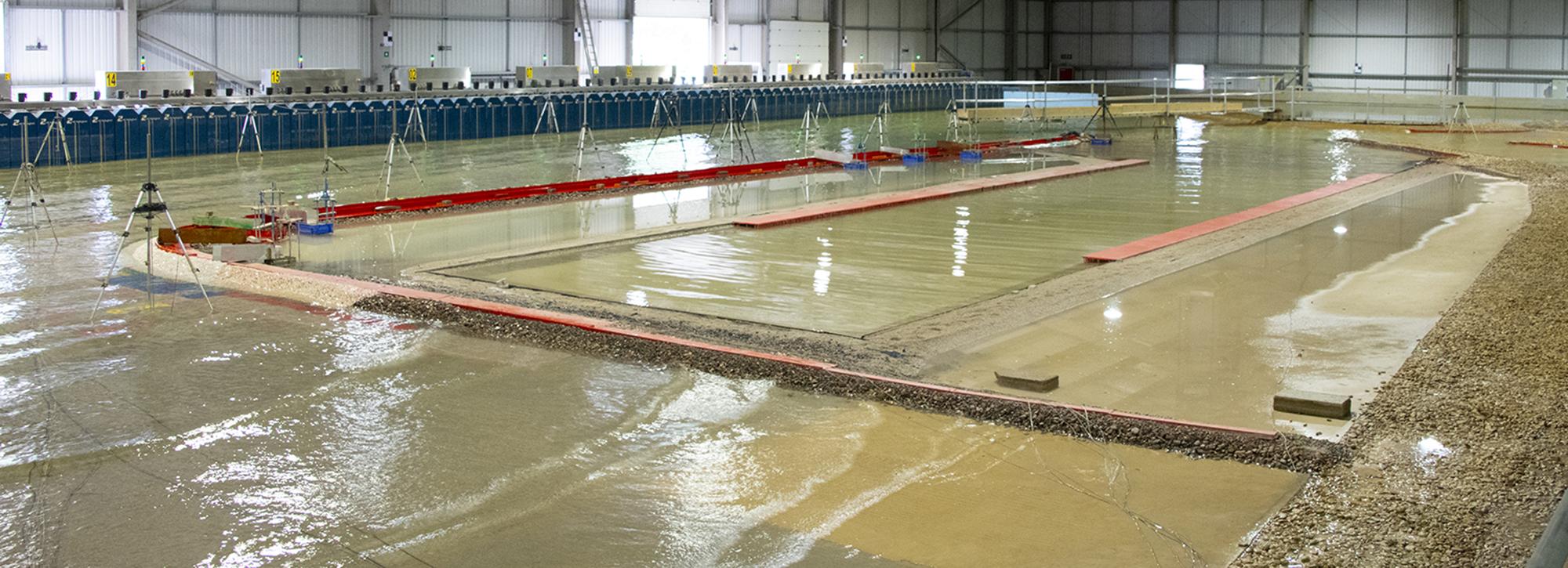
HR Wallingford’s seven wave basins range in size from 25 x 32 m to 75 x 32 m and include a 55 x 27 m wave-current basin. Our largest wave basin has a floor area of 2400 m2 and is one of the largest unobstructed hydraulic test tanks in the world. The size of our basins allows major port and harbour developments to be tested without risk of significant scale effects. 

Our basins are equipped with state of the art instrumentation including multi-element random wavemakers with active wave absorption, laser scanners, video capture and infrared tracking systems (for monitoring the movement of moored vessels).

We have 100 m of mobile multi-element wavemakers, equipped with active wave absorption to remove reflected wave energy within the basins and flumes, and a further 50 m of long crested random wave paddles. The multi-element paddles are capable of generating a full range of long crested and multidirectional seastates including:

  • JONSWAP (defined by wind speed and fetch)
  • Pierson Moskowitz
  • International Ship Structure Congress (ISSC)
  • International Towing Tank Congress (ITTC)
  • BTTP
  • Neumann
  • Bretschneider

For short crested seas, the spreading function can be defined in a number of different ways. These include cos2θ, cos6θ, cosnθ, Mitsuyasu and exponential functions.

In the wave basin models significant wave heights (Hs) of up to 0.25 m can be generated in water depths of up to 0.8 m. In addition, our wave-current basin can generate uni-or bidirectional current discharges of up to 1.2 m3/s.

A summary of our wave basins

Facility Dimensions Operating water depth Notes
Wave basin A 32 m x 25 m 0.3-0.8 m  
Wave basin B 32 m x 25 m 0.3-0.8 m Basins A, B and C can be configured to a 75 m x 32 m basin.
Wave basin C 32 m x 25 m 0.3-0.8 m  
Wave basin D 30 m x 23 m 0.3-0.8 m  
Wave-current basin E 55 m x 27 m 0.3-0.8 m With discharges up to 1.2 m3/s
Wave basin F 37 m x 30 m 0.3-0.8 m Includes a 4 m deep central pit (4 m x 4 m)
Wave basin G 35 m x 28 m 0.3-0.8 m With a 60 m3 storage sump


Get in touch

Tom Rigden

Facilities manager
Contact Profile
Headshot of Physical modelling manager, Tom Rigden

Explore more

  • All
  • Project
  • Expertise
  • News
  • Insight
  • Facility
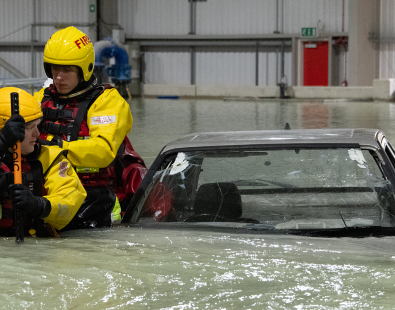
Emergency services in a water rescue training

Water rescue training

Erosion rate measurement

Erosion rate measurement

Erosion rate measurement

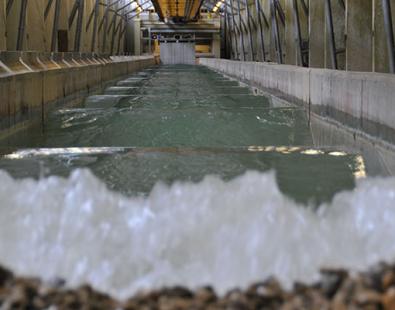
View of a wave generated in our wave flume

Wave flumes

View of a wave generated in our wave flume

Wave flumes

View of a wave generated in our wave flume

Wave flumes

View of fish pass test in volumetric flow flume

Volumetric flow flume

View of fish pass test in volumetric flow flume

Volumetric flow flume

View of fish pass test in volumetric flow flume

Volumetric flow flume

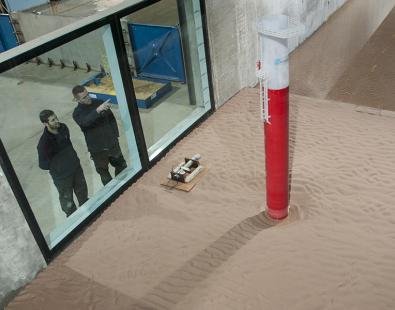
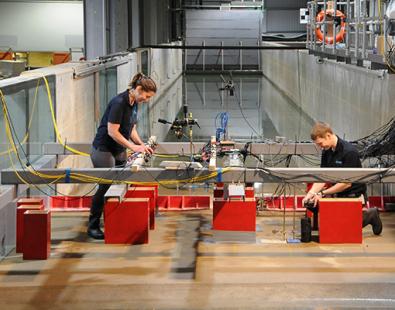
Photo of two people working on the tsunami simulator

Tsunami simulator

Photo of two people working on the tsunami simulator

Tsunami simulator

We are global leaders and independent experts in how to live and work sustainably with water

Social media

  • BlueSky
  • LinkedIn
  • YouTube

Expertise

  • Coastal & marine
  • Energy transition
  • Water & climate
  • Software solutions
  • Equipment & technology

Company

  • About
  • Careers
  • News
  • Insights
  • Sustainability

Legal

  • Privacy & data protection
  • Policies
  • Modern slavery statement
  • Terms & conditions
  • Sitemap
© 2026 HR Wallingford
Contact