Secondary nav 2022

  • Equipment
  • Software
  • Training

Main navigation 2022

  • About
    • About HR Wallingford
    • Our leadership
    • Our people
    • Our impact
      • Annual report & financial statements
      • Gender pay
      • Social impact
      • Sustainability
    • Our story
    • News
    • Insight articles
    • Policies
  • Projects
  • Expertise
    • Coastal & marine sustainability
      • Coastal hazards & resilience
      • Coastal morphology & sediment dynamics
      • Dredging and sediment management
      • Marine & coastal environment
      • Ports, harbours and shipping
      • Subsea engineering
      • Waterfronts, marinas and resorts
    • Energy transition
      • Fixed offshore wind
      • Floating offshore wind
      • Liquified gas & transition fuels
      • Nuclear
      • Wave, tidal, solar & hydropower
    • Water & climate resilience
      • Dams & reservoirs
      • Freshwater environment
      • Integrated flood management
      • Surface water systems
      • Water management for climate resilient development
      • Water supply & drought resilience
  • Facilities
    • Explore our facilities
    • Ship simulation
      • Australia Ship Simulation Centre
      • UK Ship Simulation Centre
    • Physical modelling
      • Fast Flow Facility
      • Tsunami simulator
      • Volumetric flow flume
      • Wave basins
      • Wave flumes
      • Erosion rate measurement
      • Water rescue training
  • Careers
    • Careers overview
    • Working at HR Wallingford
    • Job opportunities
  • Contact
  • About
    • About HR Wallingford
    • Our leadership
    • Our people
    • Our impact
      • Annual report & financial statements
      • Gender pay
      • Social impact
      • Sustainability
    • Our story
    • News
    • Insight articles
    • Policies
  • Projects
  • Expertise
    • Coastal & marine sustainability
      • Coastal hazards & resilience
      • Coastal morphology & sediment dynamics
      • Dredging and sediment management
      • Marine & coastal environment
      • Ports, harbours and shipping
      • Subsea engineering
      • Waterfronts, marinas and resorts
    • Energy transition
      • Fixed offshore wind
      • Floating offshore wind
      • Liquified gas & transition fuels
      • Nuclear
      • Wave, tidal, solar & hydropower
    • Water & climate resilience
      • Dams & reservoirs
      • Freshwater environment
      • Integrated flood management
      • Surface water systems
      • Water management for climate resilient development
      • Water supply & drought resilience
  • Facilities
    • Explore our facilities
    • Ship simulation
      • Australia Ship Simulation Centre
      • UK Ship Simulation Centre
    • Physical modelling
      • Fast Flow Facility
      • Tsunami simulator
      • Volumetric flow flume
      • Wave basins
      • Wave flumes
      • Erosion rate measurement
      • Water rescue training
  • Careers
    • Careers overview
    • Working at HR Wallingford
    • Job opportunities
  • Contact
  1. Home >
  2. Facilities >
  3. Physical modelling >
  4. Wave flumes

Wave flumes

Share
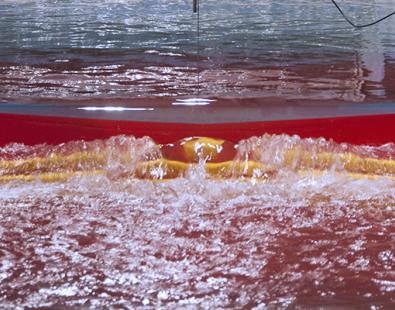
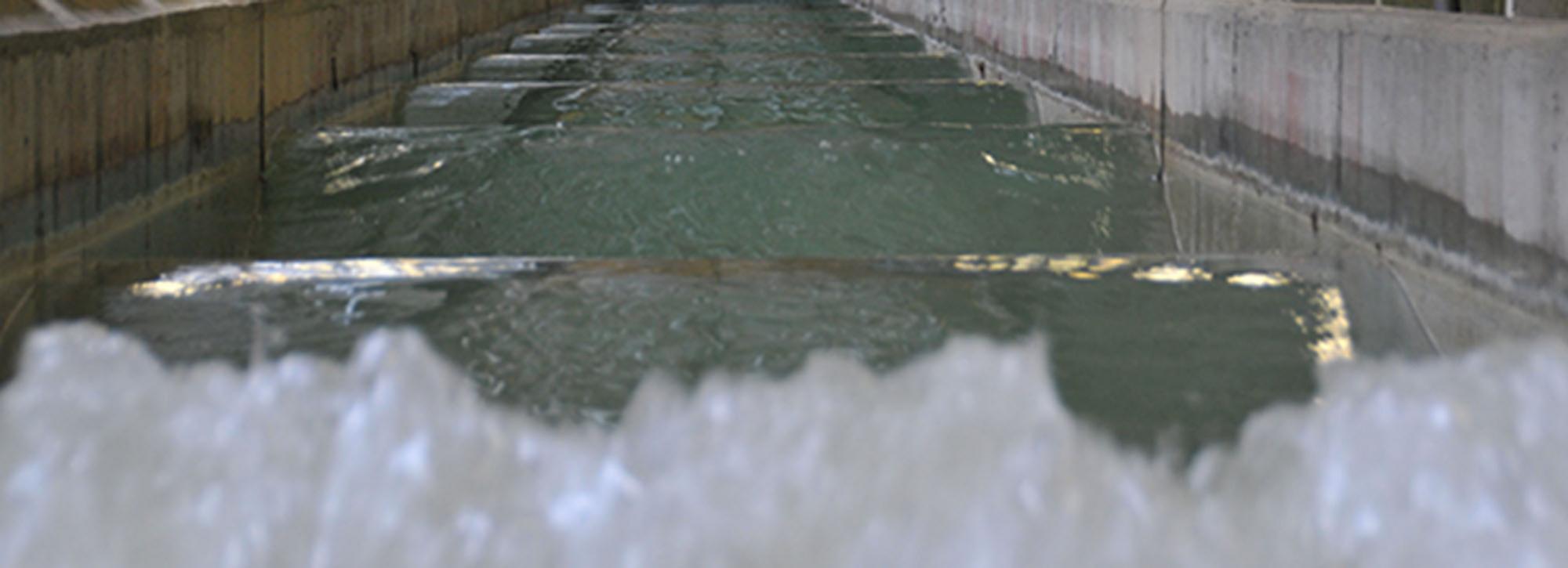
View of a wave formed in our physical wave flume model

HR Wallingford’s 2D wave flumes are where the majority of our coastal studies start. We use them to optimise and validate sections of revetment and breakwater before moving on to more complex 3D investigations. Our flumes are equipped with the same range of state of the art equipment and instrumentation as our wave basins, including laser scanning and video capture.

We have two wave flumes that are 40 m long and 1.2 m wide, with a maximum operating depth of 1.0 m. Each flume is equipped with a wavemaker that can produce both regular and random waves.

Flume tests are generally carried out to assess the performance of a cross-section when incident
waves are close to normal to the structure. To minimise scale effects, relatively large models are constructed with scales ranging between 1:10 to 1:40.

Wave generation

The flume wavemakers can create random wave trains of any spectral shape, including the standard JONSWAP and Pierson- Moskowitz spectra. We can generate model waves of up to 0.3 m in water depths of up to 1.0 m. Active wave absorption systems ensure that wave reflections from the test structure are absorbed, minimising reflected wave energy levels.

Model construction

The bathymetry is constructed in cement mortar to ensure that wave processes such as shoaling and breaking are correctly reproduced. The cross-section is built in a part of the flume that can be isolated. The means the structure can be modified quickly between tests, without the need to drain the whole of the flume.

How our wave flumes are used

Flume tests are used to fully explore the performance of a structure under a range of sea state conditions and to refine the cross-sectional design.

We use our flumes to investigate:

  • stability of armour layers
  • structure run-up performance
  • overtopping performance of the structure -  mean, peak or wave by wave discharge
  • wave reflections from, and transmission through, the structure
  • the susceptibility of the structure to toe scour
  • wave forces or pressures imposed on the structure.

An overview of our wave flumes

Facility Dimensions Operating water depth Notes
Wave flume 1 45 m x 1.2 m 1.2-1.5 m Piston paddle wavemaker
Wave flume 2 45 m x 1.2 m 1.2-1.5 m Piston paddle wavemaker

Get in touch

Tom Rigden

Facilities manager
Contact Profile
Headshot of Physical modelling manager, Tom Rigden

Explore more

  • All
  • Project
  • Expertise
  • News
  • Insight
  • Facility
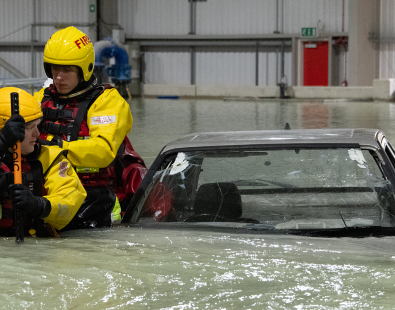
Emergency services in a water rescue training

Water rescue training

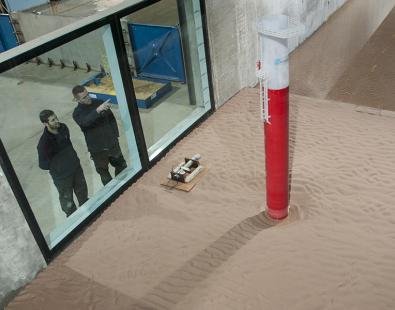
Erosion rate measurement

Erosion rate measurement

Erosion rate measurement

View of fish pass test in volumetric flow flume

Volumetric flow flume

View of fish pass test in volumetric flow flume

Volumetric flow flume

View of fish pass test in volumetric flow flume

Volumetric flow flume

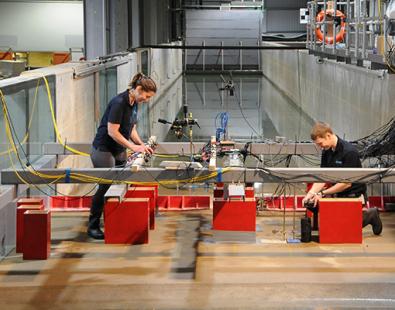
Photo of two people working on the tsunami simulator

Tsunami simulator

Photo of two people working on the tsunami simulator

Tsunami simulator

Photo of two people working on the tsunami simulator

Tsunami simulator

View from inside our ship simulation center in Australia

Australia Ship Simulation Centre

Wave basins

We are global leaders and independent experts in how to live and work sustainably with water

Social media

  • BlueSky
  • LinkedIn
  • YouTube

Expertise

  • Coastal & marine
  • Energy transition
  • Water & climate
  • Software solutions
  • Equipment & technology

Company

  • About
  • Careers
  • News
  • Insights
  • Sustainability

Legal

  • Privacy & data protection
  • Policies
  • Modern slavery statement
  • Terms & conditions
  • Sitemap
© 2026 HR Wallingford
Contact