Secondary nav 2022

  • Equipment
  • Software
  • Training

Main navigation 2022

  • About
    • About HR Wallingford
    • Our leadership
    • Our people
    • Our impact
      • Annual report & financial statements
      • Gender pay
      • Social impact
      • Sustainability
    • Our story
    • News
    • Insight articles
    • Policies
  • Projects
  • Expertise
    • Coastal & marine sustainability
      • Coastal hazards & resilience
      • Coastal morphology & sediment dynamics
      • Dredging and sediment management
      • Marine & coastal environment
      • Ports, harbours and shipping
      • Subsea engineering
      • Waterfronts, marinas and resorts
    • Energy transition
      • Fixed offshore wind
      • Floating offshore wind
      • Liquified gas & transition fuels
      • Nuclear
      • Wave, tidal, solar & hydropower
    • Water & climate resilience
      • Dams & reservoirs
      • Freshwater environment
      • Integrated flood management
      • Surface water systems
      • Water management for climate resilient development
      • Water supply & drought resilience
  • Facilities
    • Explore our facilities
    • Ship simulation
      • Australia Ship Simulation Centre
      • UK Ship Simulation Centre
    • Physical modelling
      • Fast Flow Facility
      • Tsunami simulator
      • Volumetric flow flume
      • Wave basins
      • Wave flumes
      • Erosion rate measurement
      • Water rescue training
  • Careers
    • Careers overview
    • Working at HR Wallingford
    • Job opportunities
  • Contact
  • About
    • About HR Wallingford
    • Our leadership
    • Our people
    • Our impact
      • Annual report & financial statements
      • Gender pay
      • Social impact
      • Sustainability
    • Our story
    • News
    • Insight articles
    • Policies
  • Projects
  • Expertise
    • Coastal & marine sustainability
      • Coastal hazards & resilience
      • Coastal morphology & sediment dynamics
      • Dredging and sediment management
      • Marine & coastal environment
      • Ports, harbours and shipping
      • Subsea engineering
      • Waterfronts, marinas and resorts
    • Energy transition
      • Fixed offshore wind
      • Floating offshore wind
      • Liquified gas & transition fuels
      • Nuclear
      • Wave, tidal, solar & hydropower
    • Water & climate resilience
      • Dams & reservoirs
      • Freshwater environment
      • Integrated flood management
      • Surface water systems
      • Water management for climate resilient development
      • Water supply & drought resilience
  • Facilities
    • Explore our facilities
    • Ship simulation
      • Australia Ship Simulation Centre
      • UK Ship Simulation Centre
    • Physical modelling
      • Fast Flow Facility
      • Tsunami simulator
      • Volumetric flow flume
      • Wave basins
      • Wave flumes
      • Erosion rate measurement
      • Water rescue training
  • Careers
    • Careers overview
    • Working at HR Wallingford
    • Job opportunities
  • Contact
  1. Home >
  2. Equipment & Technology >
  3. Towing carriages and multi-motion carriages
Towing carriages and multi-motion carriages

Share
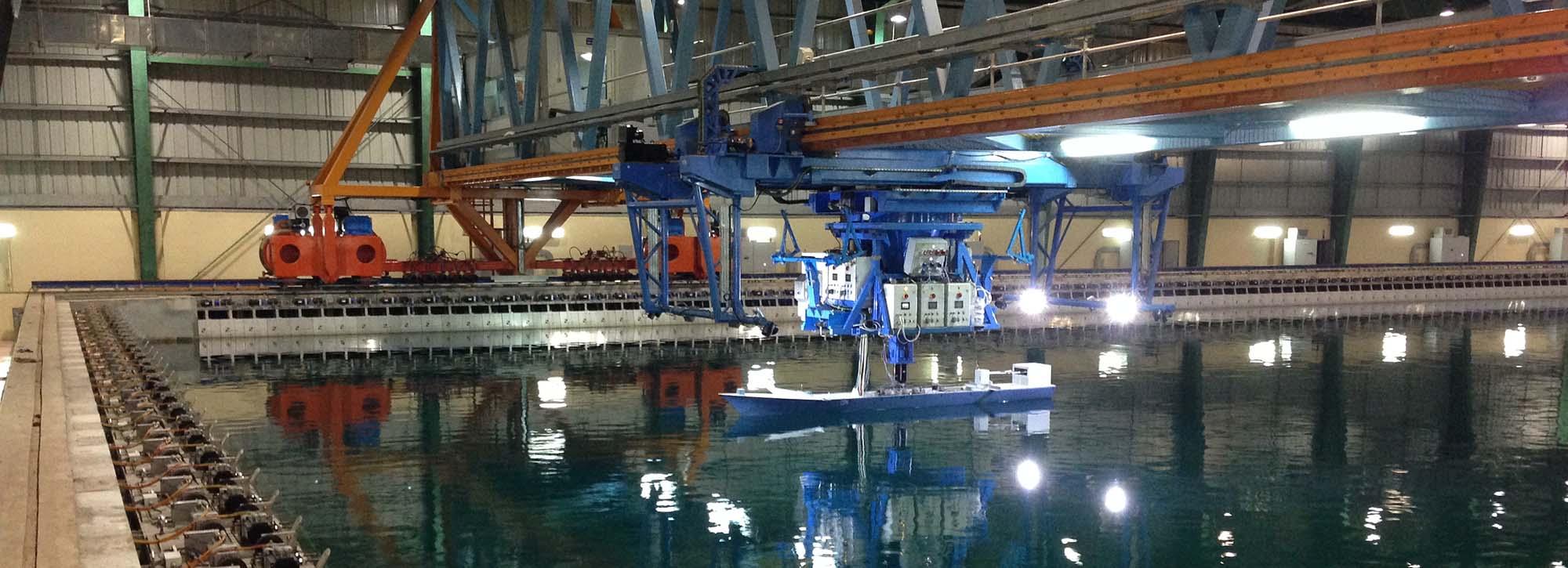
View of a towing carriage above physical models

We design towing carriages for marine research institutes, universities and educational institutes.

Our self-propelled carriages are installed on rails above towing tanks, sea-keeping and manoeuvring basins, ocean basins, flumes or ice tanks. They are used to tow scaled, instrumented models through still water, waves or ice. We supply a wide range of sizes and configurations, from small educational carriages for university laboratories, through to high speed towing carriages for ship design evaluation and research. We also design and supply multi-axis motion carriages for sea-keeping and manoeuvring basins and ocean basins. These have an integrated sub-carriage for forced model manoeuvres using a towing system, as well as the ability to track free-sailing models. 

We build carriages for tanks from 1.5 up to 50 metres wide. The carriage speed and rails are tailored to the type of tests, vessels and model scales that the facility is designed for. For example slow, carriages with speed accuracy for ice tests or high speed carriages for naval applications.

Towing carriages for research institutes

These carriages can be either manned or unmanned and are typically more than six metres wide and over 100 metres in length with speeds greater than six metres per second. The self-propelled carriages are used for mounting precise instruments to measure forces and moments. 

We know that every project is unique; our expert team will work with you to develop a bespoke towing carriage solution that meets your specific requirements.

Towing carriages for universities and educational institutes

We design and build towing carriages for smaller research facilities based in universities and educational institutes. These carriages are designed for towing tanks from two metres or four metres wide, with a minimum length of 40 metres up to a maximum of around 60 metres. The carriages are typically designed to run at a maximum speed of three metres per second, but can run up to four metres per second if the tank is long enough.

Our unmanned carriages are light weight, rigid and robust platforms that can carry a wide variety of equipment. 

Instrumentation for use with carriages

We offer a full range of instrumentation for use with both our carriages or existing carriages. These include: 

  • Resistance dynamometers
  • Self-propulsion dynamometers
  • Open water propeller dynamometers 
  • Surface or underwater model force measuring balances
  • Detachable carriage mounted large amplitude horizontal planar motion mechanisms
  • Vertical planar motion mechanisms for underwater model manoeuvring testing
  • Model clamps and guiding arms.

Want to know more?

Visit our dedicated website: Equip-IT

Get in touch

Shaun Ross

Business Development Manager
Contact

Explore more

  • All
  • Project
  • Expertise
  • News
  • Insight
  • Facility
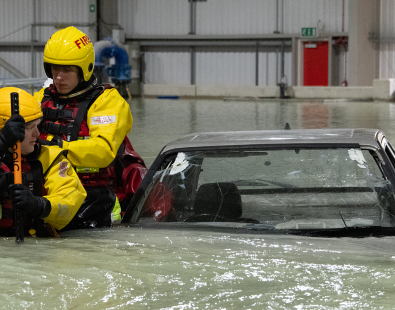
Emergency services in a water rescue training

Water rescue training

Erosion rate measurement

Erosion rate measurement

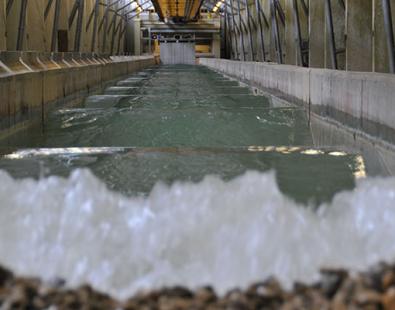
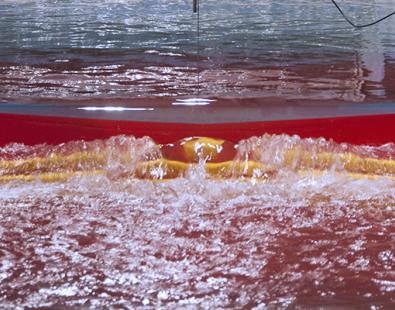
View of a wave generated in our wave flume

Wave flumes

View of a wave generated in our wave flume

Wave flumes

View of fish pass test in volumetric flow flume

Volumetric flow flume

View of fish pass test in volumetric flow flume

Volumetric flow flume

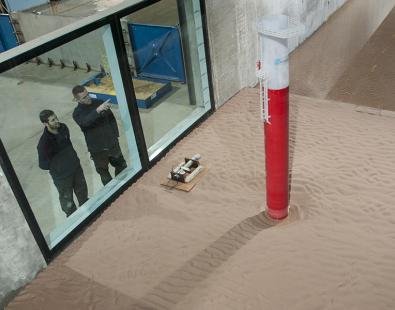
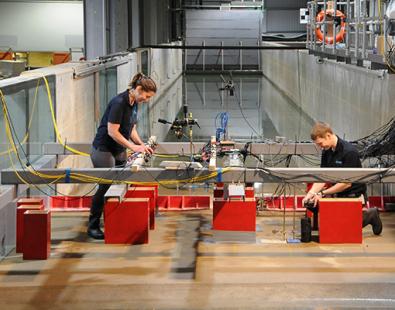
Photo of two people working on the tsunami simulator

Tsunami simulator

Photo of two people working on the tsunami simulator

Tsunami simulator

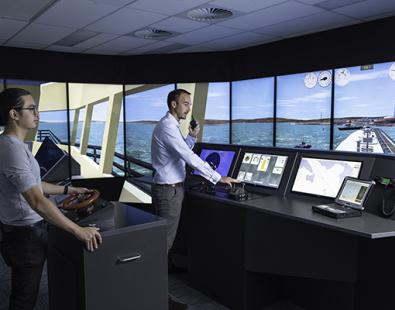
View from inside our ship simulation center in Australia

Australia Ship Simulation Centre

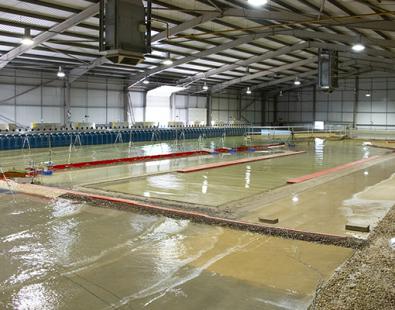
Wave basins

Wave basins

We are global leaders and independent experts in how to live and work sustainably with water

Social media

  • BlueSky
  • LinkedIn
  • YouTube

Expertise

  • Coastal & marine
  • Energy transition
  • Water & climate
  • Software solutions
  • Equipment & technology

Company

  • About
  • Careers
  • News
  • Insights
  • Sustainability

Legal

  • Privacy & data protection
  • Policies
  • Modern slavery statement
  • Terms & conditions
  • Sitemap
© 2026 HR Wallingford
Contact