Research reveals wider seabed impacts of offshore wind and climate change
The School of Ocean Sciences at Bangor University, the National Oceanography Centre (NOC) and HR Wallingford have published two new peer-reviewed research papers in Nature Portfolio journals, advancing understanding of how offshore wind infrastructure and climate change are reshaping the seabed. Both studies are outcomes of the project ECOWind-ACCELERATE (Ecological Implications of Accelerated Seabed Mobility around Windfarms), a project led by Bangor University, and as part of the ECOWind programme funded by the Natural Environment Research Council (NERC) and The Crown Estate.
The study ‘Turbulence drives seabed modification by offshore windfarms’ published in Nature Communications demonstrates that hydrodynamic forces generated by offshore wind turbine foundations can drive sediment movement over a greater area and for longer durations than previously understood. It was led by Dr Chris Unsworth, now Senior Scientist at HR Wallingford, formerly of Bangor University.
Chris said: “Our study sheds new light on something we have known about but couldn’t quantify, how eddies generated from an offshore wind farm monopile can enhance sediment movement far away from the monopile. Whilst we are good at estimating scour at a monopile (and other infrastructure), the effect of the flow field on the seabed further away has been overlooked; yet this larger turbulent effect on sediment mobility has the potential to change seabed composition and habitats. In this paper we have developed and validated a new method to do just this.”
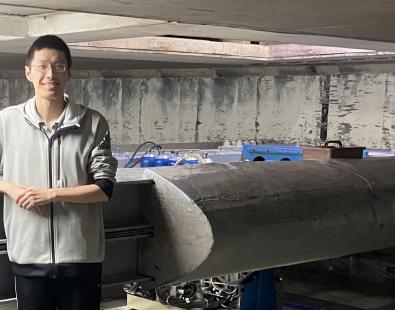
Seabed sediments, including sand, mud and gravel play a fundamental role in determining marine habitats. Using a combination of laboratory experiments, numerical modelling and observational data from an operational windfarm, the study shows that turbulence generated around monopile foundations can disturb sediments across 3-8% of the seabed within a typical windfarm. This significantly exceeds current estimates of around 1%, which do not account for these broader wake effects.
Co-author Dr Thomas Benson, Technical Director at HR Wallingford, added “The approach we took was to adapt a Reynolds-averaged Navier-Stokes model (openTELEMAC) to include the effects of turbulence on the seabed. The efficiency of this approach compared to a full Navier-Stokes model means we can simulate the turbulence generated by the monopiles across a large spatial domain and over a sufficiently long timescale to provide a better understanding of the impacts of the wake effects on the seabed.”
A companion study “Climate change affects future sea-bed mobility via storms and sea level rise' published in Communications Earth & Environment and led by Dr Julia Rulent (National Oceanography Centre), examines how climate change alone is expected to influence seabed sediment dynamics. The research indicates that rising sea levels may stabilise seabeds overall by increasing water depth, but that more intense storms could lead to more frequent short-term disturbances. It also suggests that larger sediments, such as pebbles, may become mobile in areas where they are currently stable.
Julia commented: “It is important to quantify seabed disturbance from regular tides and rare storms. By knowing both the baseline natural processes, and how they could change in future, we have meaningful context for human impacts from seabed infrastructure.”
Together, the studies provide valuable insight into how to distinguish the environmental impacts of offshore wind infrastructure from those driven by the wider climate crisis - an increasingly important consideration as offshore wind capacity expands to support the transition to low-carbon energy.
Professor Katrien Van Landeghem, who leads the ECOWind-ACCELERATE project at Bangor University, said: “These studies improve our understanding of, and ability to distinguish, the effects of the climate crisis and offsh-ore wind infrastructure on the seabed. Such future-proof impact assessment is essential for managing marine environments in a period of rapid change and for supporting the responsible development of offshore wind.”
The two research papers are available to read open access.
• Turbulence drives seabed modification by offshore windfarms
• Climate change affects future sea-bed mobility via storms and sea level rise
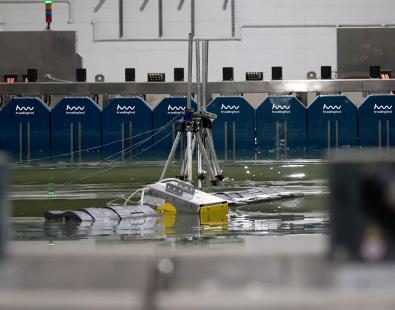
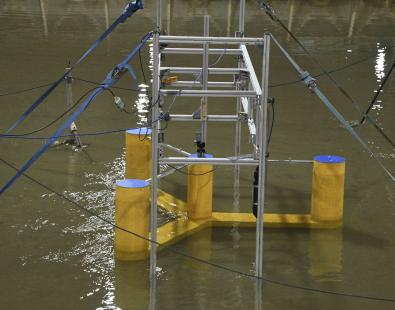
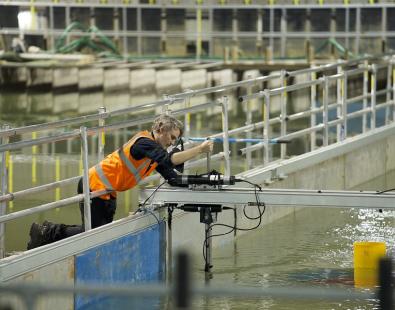
In the early stages of the project, we ran physical modelling tests with Bangor University in our laboratories, which were combined with findings by the other ECOWind-ACCELERATE project partners.
Get in touch
Helen Wilcox