Secondary nav 2022

  • Equipment
  • Software
  • Training

Main navigation 2022

  • About
    • About HR Wallingford
    • Our leadership
    • Our people
    • Our impact
      • Annual report & financial statements
      • Gender pay
      • Social impact
      • Sustainability
    • Our story
    • News
    • Insight articles
    • Policies
  • Projects
  • Expertise
    • Coastal & marine sustainability
      • Coastal hazards & resilience
      • Coastal morphology & sediment dynamics
      • Dredging and sediment management
      • Marine & coastal environment
      • Ports, harbours and shipping
      • Subsea engineering
      • Waterfronts, marinas and resorts
    • Energy transition
      • Fixed offshore wind
      • Floating offshore wind
      • Liquified gas & transition fuels
      • Nuclear
      • Wave, tidal, solar & hydropower
    • Water & climate resilience
      • Dams & reservoirs
      • Freshwater environment
      • Integrated flood management
      • Surface water systems
      • Water management for climate resilient development
      • Water supply & drought resilience
  • Facilities
    • Explore our facilities
    • Ship simulation
      • Australia Ship Simulation Centre
      • UK Ship Simulation Centre
    • Physical modelling
      • Fast Flow Facility
      • Tsunami simulator
      • Volumetric flow flume
      • Wave basins
      • Wave flumes
      • Erosion rate measurement
      • Water rescue training
  • Careers
    • Careers overview
    • Working at HR Wallingford
    • Job opportunities
  • Contact
  1. Home >
  2. Projects >
  3. Louvre Abu Dhabi

Louvre Abu Dhabi

Share

A key feature of the architectural design of the Louvre Abu Dhabi included having water levels close to the line of sight. This required a design able to withstand varying water levels, as well as one able to tolerate any long term rises in sea levels.

Flexible high specification modelling for optimisation of architectural designs

We worked closely with our clients to incorporate all non-standard features in the physical model. Tests were carried out on a large model (scale 1:20). Key goals of the tests were to allow for optimisation of the architectural design of this flagship museum by providing a high specification model that accurately reproduced the hydrodynamics of the proposed site.

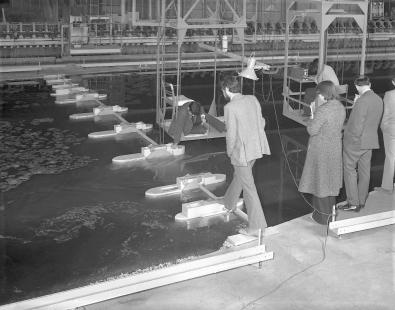
A large scale wooden segmented model provided the flexibility and high precision needed. This meant that we could rearrange, add and remove elements of the model to establish an optimised version of the model for testing.  The agreed, modified model was then tested with all wave conditions and water levels to establish the performance of the structures under normal tidal and under storm conditions.

Achieving a reduction of overtopping through testing of a variety of structures

The model of the Louvre Abu Dhabi included onshore and offshore structures. Onshore structures included the steps up to the museum which will be partially submerged, planned walkways, as well as areas of a restaurant that will be open to the sea. Offshore structures included: submerged walls and reduced water depths, plus aesthetically placed emergent structures that in combination attenuated the wave heights.

Louvre Abu Dhabi part of Abu Dhabi Saadiyat Island development

The Louvre Abu Dhabi is part of the overall development of Saadiyat Island located off the coast of the Abu Dhabi. Saadiyat Island is on the banks of the tidal river Khwar al Bighal. Opened in 2017, it is the first universal museum in the Arab world. It is designed by Pritzker prize winning architect Jean Nouvel. Saadiyat Island features shopping districts, residential and educational districts, tourism, sport and leisure districts as well as a cultural district incorporating four museums.

Get in touch

Tim Pullen
Principal Engineer
Contact Profile

Explore more

  • All
  • Project
  • Expertise
  • News
  • Insight
  • Facility
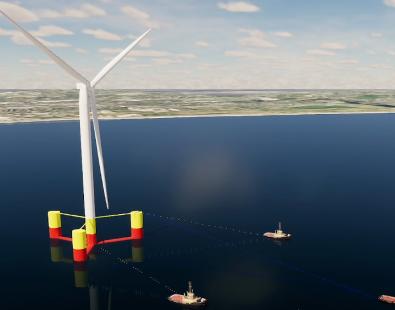
Floating offshore platform

Tackling the technical challenges to scale up floating offshore wind

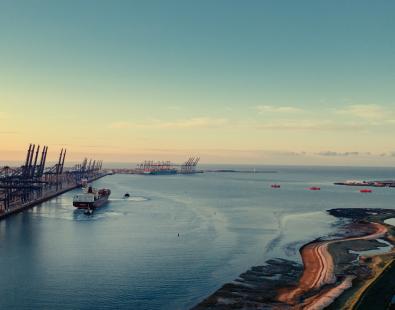
Aerial view of Felixstowe at sunrise, showcase of nature positive dredging

Dredged material doing good

The Thames Barrier – a gateway to innovation

Screenshot of a numerical simulation of an moored hydrogen carrier ship

Designing marine facilities for hydrogen: a risky business?

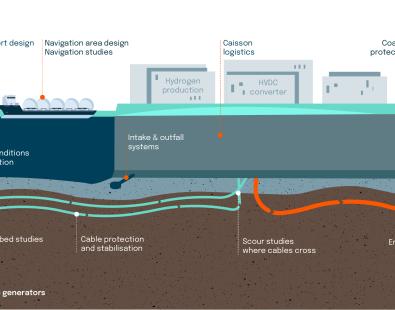
infographics showing energy islands scheme

Energy islands’ sustainable credentials rest on good advice

Ship with wind turbines moored at a port

Developing ports for floating offshore wind is an unprecedented opportunity

Three graduates with life safety jackets on boats on Port of Felixstowe.

First-hand port experience for our ship simulation graduates

Could a vital spark revive coastal shipping in UK?

View of a red LNG tanker moored at a port

Ports can thrive in a low carbon future

View of waves crashing on modelled breakwater

Preparing ports for climate change: prevention is better than cure

The curious case of a combined physical model

Accurate scaling for huge models has layers of complexity

We are global leaders and independent experts in how to live and work sustainably with water

Social media

  • BlueSky
  • LinkedIn
  • YouTube

Expertise

  • Coastal & marine
  • Energy transition
  • Water & climate
  • Software solutions
  • Equipment & technology

Company

  • About
  • Careers
  • News
  • Insights
  • Sustainability

Legal

  • Privacy & data protection
  • Policies
  • Terms & conditions
  • Sitemap
© 2026 HR Wallingford
Contact