Secondary nav 2022

  • Equipment
  • Software
  • Training

Main navigation 2022

  • About
    • About HR Wallingford
    • Our leadership
    • Our people
    • Our impact
      • Annual report & financial statements
      • Gender pay
      • Social impact
      • Sustainability
    • Our story
    • News
    • Insight articles
    • Policies
  • Projects
  • Expertise
    • Coastal & marine sustainability
      • Coastal hazards & resilience
      • Coastal morphology & sediment dynamics
      • Dredging and sediment management
      • Marine & coastal environment
      • Ports, harbours and shipping
      • Subsea engineering
      • Waterfronts, marinas and resorts
    • Energy transition
      • Fixed offshore wind
      • Floating offshore wind
      • Liquified gas & transition fuels
      • Nuclear
      • Wave, tidal, solar & hydropower
    • Water & climate resilience
      • Dams & reservoirs
      • Freshwater environment
      • Integrated flood management
      • Surface water systems
      • Water management for climate resilient development
      • Water supply & drought resilience
  • Facilities
    • Explore our facilities
    • Ship simulation
      • Australia Ship Simulation Centre
      • UK Ship Simulation Centre
    • Physical modelling
      • Fast Flow Facility
      • Tsunami simulator
      • Volumetric flow flume
      • Wave basins
      • Wave flumes
      • Erosion rate measurement
      • Water rescue training
  • Careers
    • Careers overview
    • Working at HR Wallingford
    • Job opportunities
  • Contact
  • About
    • About HR Wallingford
    • Our leadership
    • Our people
    • Our impact
      • Annual report & financial statements
      • Gender pay
      • Social impact
      • Sustainability
    • Our story
    • News
    • Insight articles
    • Policies
  • Projects
  • Expertise
    • Coastal & marine sustainability
      • Coastal hazards & resilience
      • Coastal morphology & sediment dynamics
      • Dredging and sediment management
      • Marine & coastal environment
      • Ports, harbours and shipping
      • Subsea engineering
      • Waterfronts, marinas and resorts
    • Energy transition
      • Fixed offshore wind
      • Floating offshore wind
      • Liquified gas & transition fuels
      • Nuclear
      • Wave, tidal, solar & hydropower
    • Water & climate resilience
      • Dams & reservoirs
      • Freshwater environment
      • Integrated flood management
      • Surface water systems
      • Water management for climate resilient development
      • Water supply & drought resilience
  • Facilities
    • Explore our facilities
    • Ship simulation
      • Australia Ship Simulation Centre
      • UK Ship Simulation Centre
    • Physical modelling
      • Fast Flow Facility
      • Tsunami simulator
      • Volumetric flow flume
      • Wave basins
      • Wave flumes
      • Erosion rate measurement
      • Water rescue training
  • Careers
    • Careers overview
    • Working at HR Wallingford
    • Job opportunities
  • Contact
  1. Home >
  2. Projects >
  3. Predicting the impact of underwater noise on marine life
Predicting the impact of underwater noise on marine life

Share

Underwater noise is increasing as human activities in the marine environment expand. Environmental Impact Assessment increasingly requires predictive modelling of underwater noise and assessment of the potential impact on marine life. HR Wallingford has developed HAMMER, an innovative modelling and assessment tool to investigate noise levels and the impact on species behaviour.

HR Wallingford worked with Loughborough University to develop HAMMER (Hydro-Acoustic Model for Mitigation and Ecological Response), an underwater noise propagation model which predicts noise levels at distance from a point source. The tool can also be used to investigate the impact of underwater noise on species behaviour. Further development of the tool is underway in collaboration with Bristol and Exeter Universities to determine behavioural response of fish species to underwater noise.

As underwater noise propagation can be affected by the depth of water through which the noise is travelling, as well as the sediment type the model takes into account the bathymetry and the seabed type of the study area.

Developing a 3D model

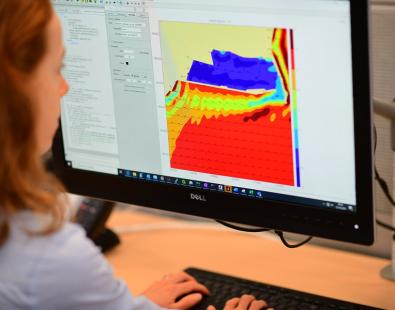
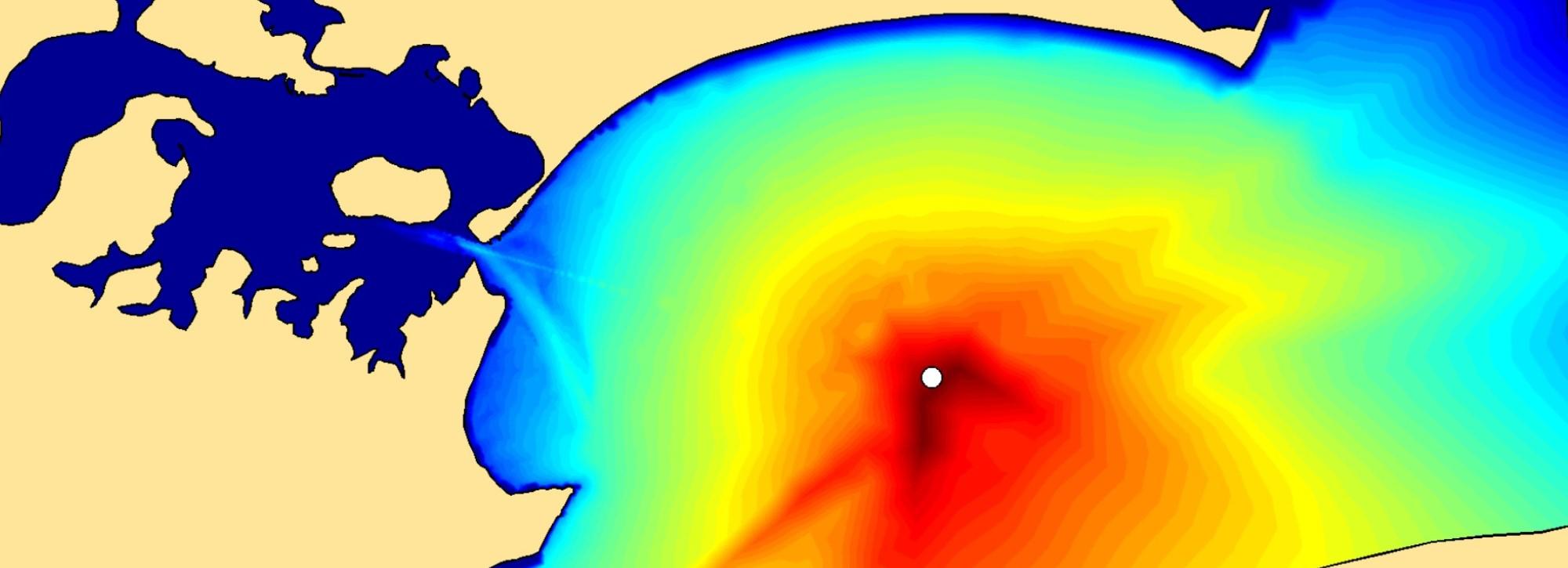
The underwater noise model is setup using the physical information from the bathymetric data and hydrodynamic model with additional data relating to the specific noise source, e.g. piling, if available.  The model predicts the propagation of noise from the source point in a 2D vertical slice, which determines the noise levels throughout the water column in a line out from the source. The 2D vertical slices of the water column radiate out from the noise source generated in all directions and depths, covering a full 360 degrees. This allows sound maps of underwater noise to be created at the water surface at throughout the water column so that the noise levels can be understood and interpreted for EIA.

Ecological response

The impact of underwater noise on marine life is of growing concern as legislation such as the European Marine Strategy Framework Directive (MSFD) recognises noise a pollutant and an issue to be investigated for EIA.

Using individual based modelling (IBM) techniques (also known as agent based modelling) the HAMMER tool is able to predict the response of a target species to underwater noise if enough behavioural data is available for the target species.  Model input data includes:

  • hearing ability – which noise levels can the species detect
  • response to noise
  • migration route – this can be from feeding to breeding grounds, or between feeding grounds if there is a seasonal shift in food availability for the target species
  • swim speeds
  • size of individuals

Other parameters which can be included are temperature and salinity tolerances of the target species, schooling behaviour and swimming depth i.e. where in the water column are they found.

Outcomes

The combined modelling techniques produce more accurate ‘sound maps’ of predicted noise levels which can then be used to develop monitoring and mitigation plans for the development. The additional ability to predict a species response to the underwater noise enables questions relating to long term impacts and effects on populations to be investigated.

Get in touch

Tom Benson
Technical Director
Contact Profile
Headshot of Scientist Tom Benson

Explore more

  • All
  • Project
  • Expertise
  • News
  • Insight
  • Facility
Aerial view of Felixstowe at sunrise, showcase of nature positive dredging

Dredged material doing good

infographics showing energy islands scheme

Energy islands’ sustainable credentials rest on good advice

Picture of a satellite in space around the Earth

Earth Observation: the final frontier for understanding water?

An aerial photo of the Brumadinho dam disaster in Brazil

Monitoring dams from space

A forest burned by bush fire with a road running through it

Securing vital healthcare supplies during natural disasters

Picture of a satellite in space around the Earth

Flood-impact forecasting: the new frontier for EO

A mosquito on a green leaf

Satellites vs mosquitoes

Could a vital spark revive coastal shipping in UK?

The curious case of a combined physical model

Programmed for scientific success

Accurate scaling for huge models has layers of complexity

View of a breakwater in a physical model

The future is bright for physical modelling

We are global leaders and independent experts in how to live and work sustainably with water

Social media

  • BlueSky
  • LinkedIn
  • YouTube

Expertise

  • Coastal & marine
  • Energy transition
  • Water & climate
  • Software solutions
  • Equipment & technology

Company

  • About
  • Careers
  • News
  • Insights
  • Sustainability

Legal

  • Privacy & data protection
  • Policies
  • Modern slavery statement
  • Terms & conditions
  • Sitemap
© 2026 HR Wallingford
Contact