Secondary nav 2022

  • Equipment
  • Software
  • Training

Main navigation 2022

  • About
    • About HR Wallingford
    • Our leadership
    • Our people
    • Our impact
      • Annual report & financial statements
      • Gender pay
      • Social impact
      • Sustainability
    • Our story
    • News
    • Insight articles
    • Policies
  • Projects
  • Expertise
    • Coastal & marine sustainability
      • Coastal hazards & resilience
      • Coastal morphology & sediment dynamics
      • Dredging and sediment management
      • Marine & coastal environment
      • Ports, harbours and shipping
      • Subsea engineering
      • Waterfronts, marinas and resorts
    • Energy transition
      • Fixed offshore wind
      • Floating offshore wind
      • Liquified gas & transition fuels
      • Nuclear
      • Wave, tidal, solar & hydropower
    • Water & climate resilience
      • Dams & reservoirs
      • Freshwater environment
      • Integrated flood management
      • Surface water systems
      • Water management for climate resilient development
      • Water supply & drought resilience
  • Facilities
    • Explore our facilities
    • Ship simulation
      • Australia Ship Simulation Centre
      • UK Ship Simulation Centre
    • Physical modelling
      • Fast Flow Facility
      • Tsunami simulator
      • Volumetric flow flume
      • Wave basins
      • Wave flumes
      • Erosion rate measurement
      • Water rescue training
  • Careers
    • Careers overview
    • Working at HR Wallingford
    • Job opportunities
  • Contact
  • About
    • About HR Wallingford
    • Our leadership
    • Our people
    • Our impact
      • Annual report & financial statements
      • Gender pay
      • Social impact
      • Sustainability
    • Our story
    • News
    • Insight articles
    • Policies
  • Projects
  • Expertise
    • Coastal & marine sustainability
      • Coastal hazards & resilience
      • Coastal morphology & sediment dynamics
      • Dredging and sediment management
      • Marine & coastal environment
      • Ports, harbours and shipping
      • Subsea engineering
      • Waterfronts, marinas and resorts
    • Energy transition
      • Fixed offshore wind
      • Floating offshore wind
      • Liquified gas & transition fuels
      • Nuclear
      • Wave, tidal, solar & hydropower
    • Water & climate resilience
      • Dams & reservoirs
      • Freshwater environment
      • Integrated flood management
      • Surface water systems
      • Water management for climate resilient development
      • Water supply & drought resilience
  • Facilities
    • Explore our facilities
    • Ship simulation
      • Australia Ship Simulation Centre
      • UK Ship Simulation Centre
    • Physical modelling
      • Fast Flow Facility
      • Tsunami simulator
      • Volumetric flow flume
      • Wave basins
      • Wave flumes
      • Erosion rate measurement
      • Water rescue training
  • Careers
    • Careers overview
    • Working at HR Wallingford
    • Job opportunities
  • Contact
  1. Home >
  2. Projects >
  3. Floating wind design: analysing deep sea challenges for the Stinger Keel
Floating wind design: analysing deep sea challenges for the Stinger Keel

Share
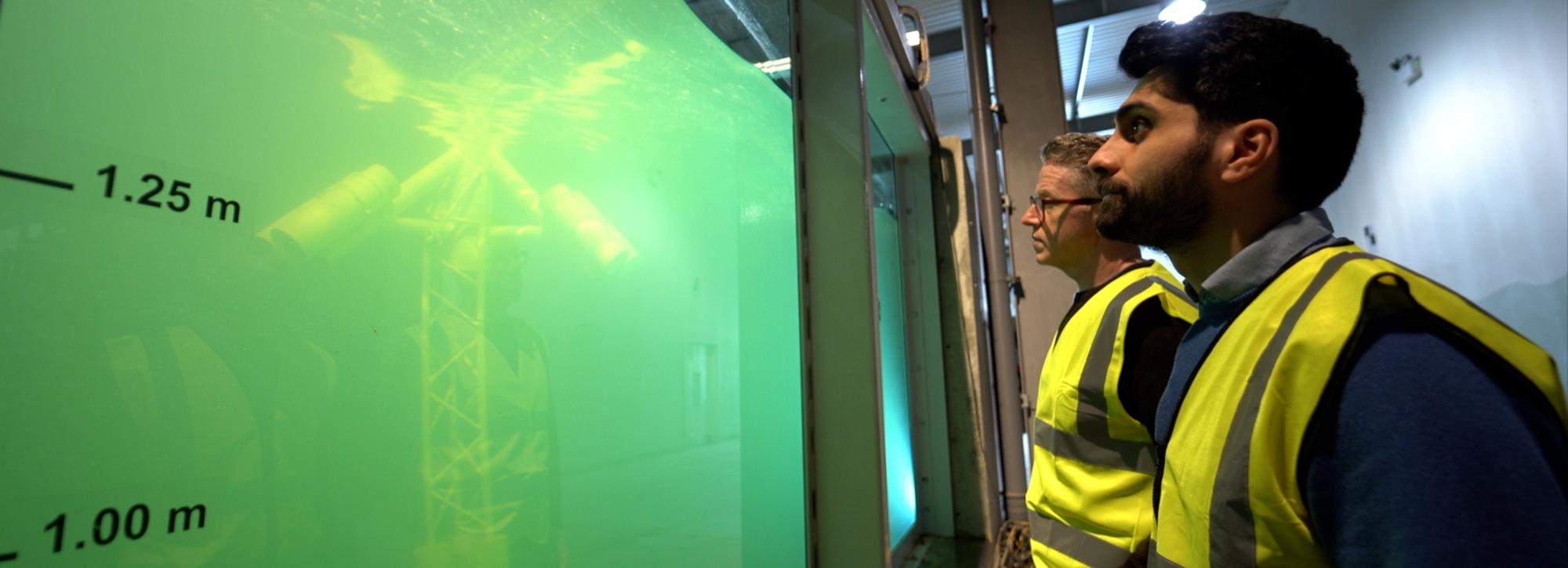
Two HR Wallingford staff looking at the Fast Flow Facility with Stinger Keel model

Our analysis of a cutting-edge floating wind foundation design – the Stinger Keel – is helping address the challenges of making huge turbines safe and affordable to build and install in the harsh conditions of deep seas.

Being able to operate safely and efficiently in deeper waters is key to helping the offshore wind industry expand, helping meet carbon reduction targets. Using floating turbines in high seas will become increasingly essential, as suitable fixed bottom sites will soon become congested in some countries, while others don’t have the luxury of a shallow continental shelf.

However, the harsher environment brings challenges that need addressing. Wind turbine foundations and mooring systems need to cope with more extreme wave and hydrodynamic forces, and the turbines with stronger wind forces.

Our engineers have been helping solve these issues, using physical and computational models to examine the Stinger Keel’s hydrodynamic performance as part of a one-year project funded by Innovate UK. Our simulations showed the wave pressures exerted on the Stinger Keel foundation structure under a range of conditions. Properly understanding and quantifying these hydrodynamic forces is key to a successful engineering design.

Our data and modelling will be used by consortium partners to perform further structural analysis and refine the design. Having determined the most efficient dimensions for the design, construction costs can be calculated, which towards the end of the project will be fed into calculations of the cost per unit of energy produced – the levelized cost of energy.
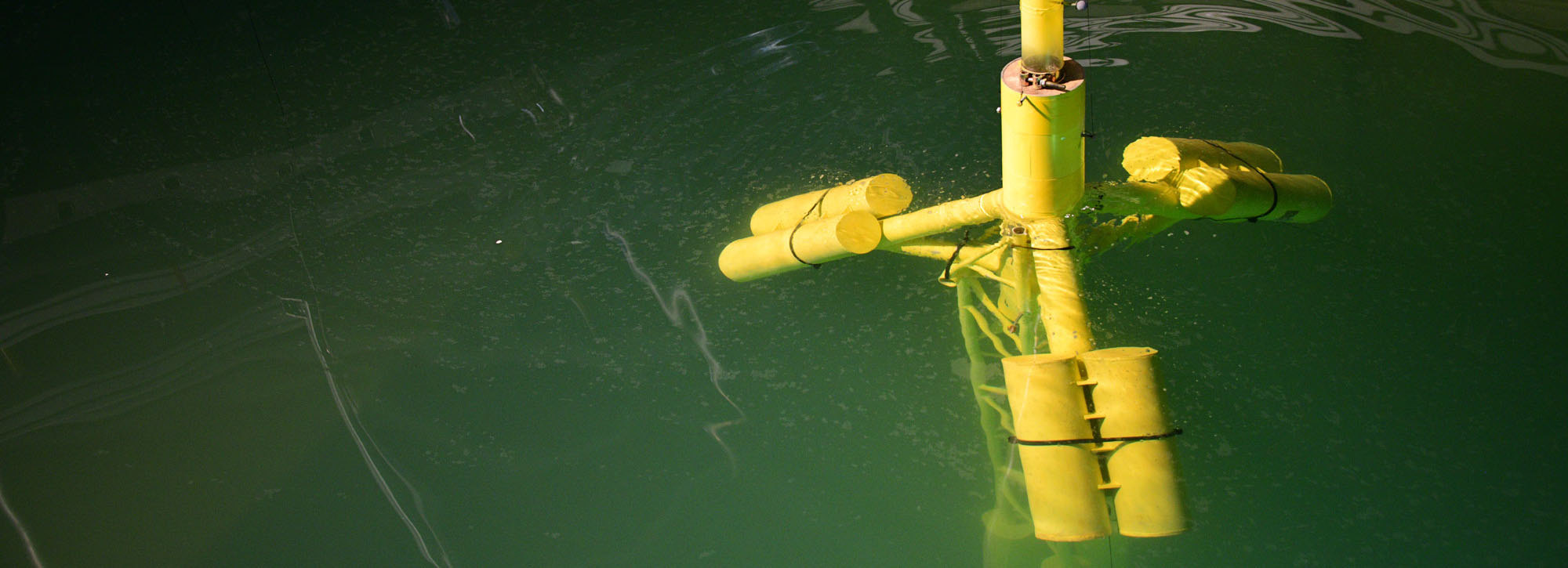
view of floating turbines in physical models

Detailed scope

Physical modelling

  • Model (1:67 scale) built of the Stinger Keel structure, including its folding hinge.
  • Swing tests measured the oscillation and extracted mass properties.
  • Un-moored and moored decay tests in still water investigating natural periods and damping.
  • Model tested in our Fast Flow Facility under irregular and regular wave conditions and two different mooring configurations.

Numerical modelling

  • Developed OpenFAST model.
  • Calibrated and validated using data from the physical modelling.

Get in touch

Iain Gunn
Sector Lead – Energy
Contact Profile

Explore more

  • All
  • Project
  • Expertise
  • News
  • Insight
  • Facility

Floating offshore wind towing research to feed into collaboration

View of testing ECOwind

ECOWind begins investigating marine impact of offshore wind growth

We are global leaders and independent experts in how to live and work sustainably with water

Social media

  • BlueSky
  • LinkedIn
  • YouTube

Expertise

  • Coastal & marine
  • Energy transition
  • Water & climate
  • Software solutions
  • Equipment & technology

Company

  • About
  • Careers
  • News
  • Insights
  • Sustainability

Legal

  • Privacy & data protection
  • Policies
  • Modern slavery statement
  • Terms & conditions
  • Sitemap
© 2026 HR Wallingford
Contact