Secondary nav 2022

  • Equipment
  • Software
  • Training

Main navigation 2022

  • About
    • About HR Wallingford
    • Our leadership
    • Our people
    • Our impact
      • Annual report & financial statements
      • Gender pay
      • Social impact
      • Sustainability
    • Our story
    • News
    • Insight articles
    • Policies
  • Projects
  • Expertise
    • Coastal & marine sustainability
      • Coastal hazards & resilience
      • Coastal morphology & sediment dynamics
      • Dredging and sediment management
      • Marine & coastal environment
      • Ports, harbours and shipping
      • Subsea engineering
      • Waterfronts, marinas and resorts
    • Energy transition
      • Fixed offshore wind
      • Floating offshore wind
      • Liquified gas & transition fuels
      • Nuclear
      • Wave, tidal, solar & hydropower
    • Water & climate resilience
      • Dams & reservoirs
      • Freshwater environment
      • Integrated flood management
      • Surface water systems
      • Water management for climate resilient development
      • Water supply & drought resilience
  • Facilities
    • Explore our facilities
    • Ship simulation
      • Australia Ship Simulation Centre
      • UK Ship Simulation Centre
    • Physical modelling
      • Fast Flow Facility
      • Tsunami simulator
      • Volumetric flow flume
      • Wave basins
      • Wave flumes
      • Erosion rate measurement
      • Water rescue training
  • Careers
    • Careers overview
    • Working at HR Wallingford
    • Job opportunities
  • Contact
  • About
    • About HR Wallingford
    • Our leadership
    • Our people
    • Our impact
      • Annual report & financial statements
      • Gender pay
      • Social impact
      • Sustainability
    • Our story
    • News
    • Insight articles
    • Policies
  • Projects
  • Expertise
    • Coastal & marine sustainability
      • Coastal hazards & resilience
      • Coastal morphology & sediment dynamics
      • Dredging and sediment management
      • Marine & coastal environment
      • Ports, harbours and shipping
      • Subsea engineering
      • Waterfronts, marinas and resorts
    • Energy transition
      • Fixed offshore wind
      • Floating offshore wind
      • Liquified gas & transition fuels
      • Nuclear
      • Wave, tidal, solar & hydropower
    • Water & climate resilience
      • Dams & reservoirs
      • Freshwater environment
      • Integrated flood management
      • Surface water systems
      • Water management for climate resilient development
      • Water supply & drought resilience
  • Facilities
    • Explore our facilities
    • Ship simulation
      • Australia Ship Simulation Centre
      • UK Ship Simulation Centre
    • Physical modelling
      • Fast Flow Facility
      • Tsunami simulator
      • Volumetric flow flume
      • Wave basins
      • Wave flumes
      • Erosion rate measurement
      • Water rescue training
  • Careers
    • Careers overview
    • Working at HR Wallingford
    • Job opportunities
  • Contact
  1. Home >
  2. Equipment & Technology >
  3. Wavemaker design and manufacture
Wavemaker design and manufacture

Share
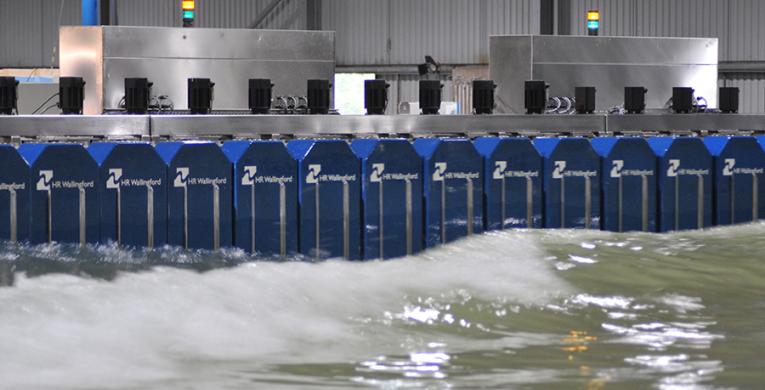
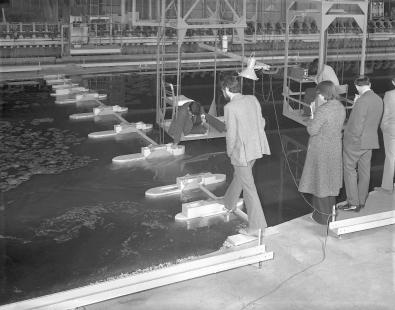
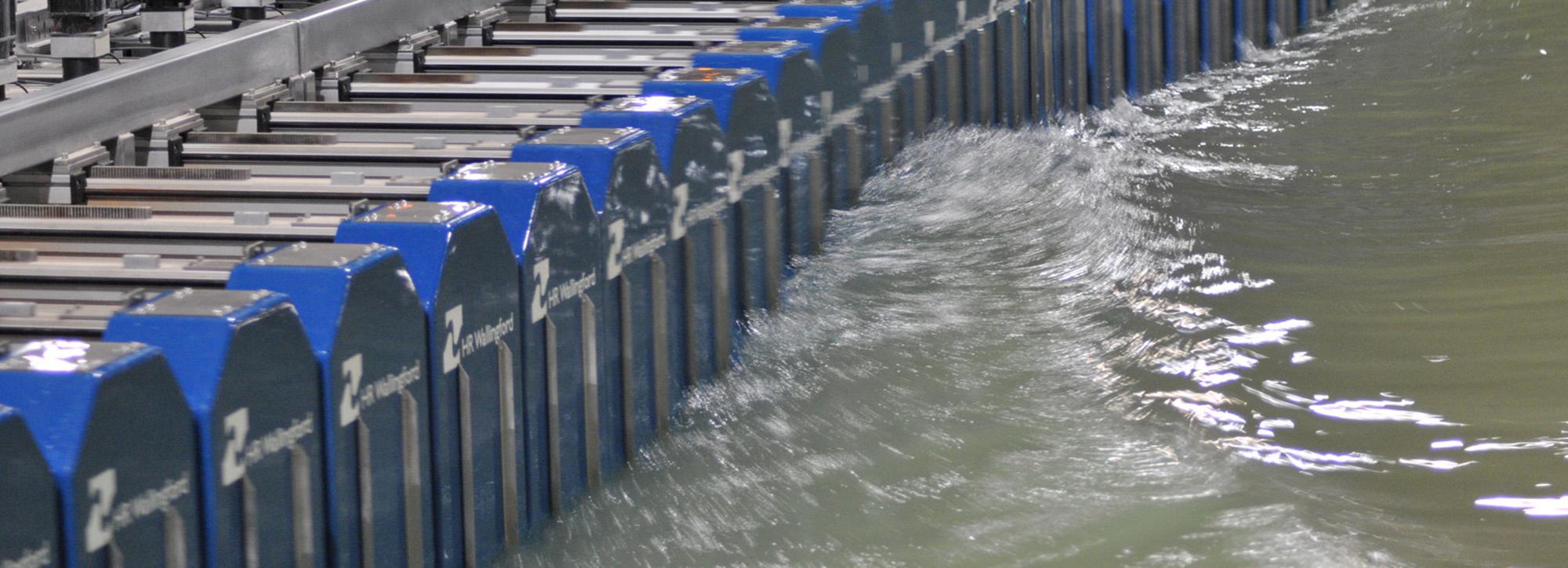
View of HR Wallingford multi-element wavemaker in action

We are proud to have supplied wave generation systems and instrumentation to more than 300 institutions worldwide.

To investigate wave processes, or test the design of ports and harbours, coastal protection schemes and off-shore structures, engineers and scientists must be able to realistically simulate a wide range of wave conditions in a physical model.

We’ve been modelling coastal and marine structures for more than 70 years, and we use this expertise to design state of the art physical wave generation systems for use in hydraulic, coastal and marine research facilities. We also supply the full suite of instrumentation and software needed to reliably collect and analyse results. Because our designs have been rigorously proven in use our own research and consultancy projects, you can be confident that they satisfy the most stringent user requirements.

Innovation in wave generation

All our wavemakers can generate random waves and come equipped with active wave absorption for precise control of wave conditions within your flume, wave basin or towing tank.

Our wavemakers can be designed for shallow water or deep water applications from the narrowest of flumes to the widest of 3D basins. Where very wide facilities are involved our multi-element wavemakers are made up of individual modules that can be linked together to create long and short crested waves together with the capability of oblique waves at specific locations in the facility using side wall reflection techniques.

The wavemakers are electrically powered using the latest in servo-motor technology and easy to maintain with all precision components above water, their stainless steel construction delivers a design life in excess of 20 years. 

As a hugely experienced user and supplier of wavemakers, instrumentation and software, we know that nothing is ever standard. We’re constantly developing new products, upgrading and customising existing ones, and looking to develop new techniques and technologies to meet the constant demands of our own engineers and scientists and we recognise our customers face the same challenges.

If you can’t find what you need please contact us to discuss your challenges and requirements. From modifications and adaptations of existing products to complete custom solutions, we can help. 

Our wave generation systems in action

Key features of our wavemakers

  • Generates short and long-crested random waves at normal and oblique
  • Active wave absorption guarantees precise control of wave conditions
  • Wet-backed piston paddles ensure that performance is not limited by stroke for shallow water applications
  • Stainless steel construction delivers a design life in excess of 20 years
  • Digital AC servo-motors provide precise control and rapid response
  • Designed and supplied in multi paddle modules for ease and speed of installation
  • Easy to maintain
Example of a piston wavemaker

Piston paddle wavemakers

Our piston paddle wavemakers are typically used in shallow water basin and flumes up to around a  metre in depth. For flumes, depending on the width, there will be a single paddle that could have one or two actuators to drive it. The multi-element modules are self-contained with eight or ten paddles of varying paddle widths between 0.4 m and 0.75 m to make up the desired full system width. This enables them to be easily installed, moved to different positions within the basin and to be extended as required.
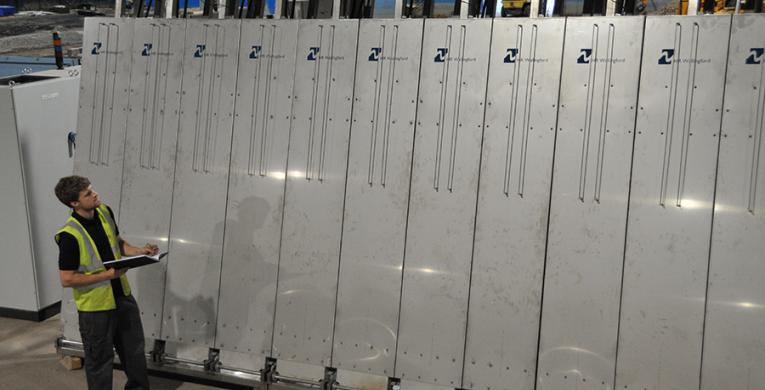
Example of one of our hinged paddle wavemakers

Hinged paddle wavemakers

Our hinged paddle wavemakers are used in deep water basins and towing tanks. These hinge type paddles are also supplied in modular frames, typically with four or five paddles, that are fixed to the inside of the facility with dedicated brackets that are designed for easy removal of modules for routine maintenance without the need to drain down the water in the facility.

Custom-built with support at every stage

Every wavemaker we supply is custom-built to meet our client’s specific requirements, and is equipped with our active wave absorption system. Installation is straightforward; we provide commissioning, training and on-going support.

Want to know more?

Visit our dedicated website

Get in touch

Simon Tiedeman

Director of Equipment & Technology
Contact Profile

Explore more

  • All
  • Project
  • Expertise
  • News
  • Insight
  • Facility
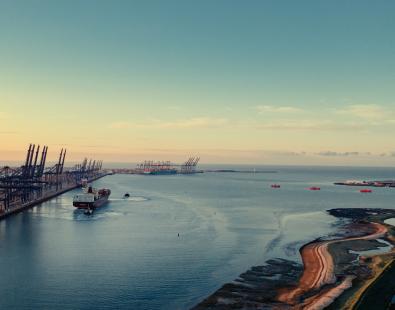
Aerial view of Felixstowe at sunrise, showcase of nature positive dredging

Dredged material doing good

The Thames Barrier – a gateway to innovation

Screenshot of a numerical simulation of an moored hydrogen carrier ship

Designing marine facilities for hydrogen: a risky business?

infographics showing energy islands scheme

Energy islands’ sustainable credentials rest on good advice

Ship with wind turbines moored at a port

Developing ports for floating offshore wind is an unprecedented opportunity

Three graduates with life safety jackets on boats on Port of Felixstowe.

First-hand port experience for our ship simulation graduates

Picture of a satellite in space around the Earth

Earth Observation: the final frontier for understanding water?

An aerial photo of the Brumadinho dam disaster in Brazil

Monitoring dams from space

A forest burned by bush fire with a road running through it

Securing vital healthcare supplies during natural disasters

Picture of a satellite in space around the Earth

Flood-impact forecasting: the new frontier for EO

A mosquito on a green leaf

Satellites vs mosquitoes

Could a vital spark revive coastal shipping in UK?

We are global leaders and independent experts in how to live and work sustainably with water

Social media

  • BlueSky
  • LinkedIn
  • YouTube

Expertise

  • Coastal & marine
  • Energy transition
  • Water & climate
  • Software solutions
  • Equipment & technology

Company

  • About
  • Careers
  • News
  • Insights
  • Sustainability

Legal

  • Privacy & data protection
  • Policies
  • Modern slavery statement
  • Terms & conditions
  • Sitemap
© 2026 HR Wallingford
Contact