Dam and levee models assessed for predicting internally initiated breaches
On behalf of Electricité de France (EDF), we tested and reviewed the performance of models designed to predict internally initiated breaches through dams and levees. While many models had the potential to predict the observed conditions, the review showed that some perform better and more consistently than others.

Dams and levees typically breach through overtopping or erosion, which has been initiated internally and eventually leads to open breach and catastrophic failure. A range of different methods exist to predict potential breach conditions, with physically based predictive models offering the most flexible tools for engineers wishing to assess performance and flood risk.
However, not all breach models allow for the replication of conditions initiated by internal erosion – simulated from a defined internal pipe through to open breach and catastrophic failure of the dam or levee. Furthermore, different models adopt different methodologies.
As it was unclear which approaches offered the best solutions, this project reviewed, tested and validated the performance of existing, industry applicable breach prediction models – assessing models which can be applied by practising engineers, are commercially available, use parameters which can be reasonably estimated or measured, and take seconds or minutes to run.
Certain models proved more consistent than others
The findings showed that many models have the potential to predict the observed conditions given use of the right parameters and the correct model application. However, some models perform better and more consistently than others.
The study also showed that using the mean of Monte Carlo modelling results gave good estimations for many parameters and could be within ±15-20% of observed data. The predicted result uncertainty bands arising from uncertainty in modelling parameters are very large.
We also found that pipe formation and roof collapse routines within the models do affect breach peak outflow/time to peak outflow estimations, but the impacts appear to be smaller than might be initially assumed.
The accuracy of the modelling results depended significantly on the understanding and judgement of the modeller; significant differences in applications can be seen within this group of experts, relating to detailed knowledge of model setup.
Comparing predictive breach modelling results to simple peak discharge equations showed that the range of prediction from simplified equations (depending on high/med/low soil erodibility) is larger than from the physically based models.
Improving our ability to measure and predict and apply soil erodibility (Kd) more accurately for different dams and levees is the action most likely to improve the accuracy of breach modelling.
The full findings from this research are presented in the report ‘Breach Model Validation Programme Internal Erosion Initiated Breach: Model Performance Review & Validation’
How we approached the modelling work
A total of four phases of modelling work were undertaken, with five different models being tested (AREBA, DLBreach, EMBREA, Rupro and WinDAM C). Throughout the programme of work from 2019 to 2024 15 different modellers participated comprising developers, researchers and practitioners, drawn from both Europe and the USA.
The different phases of modelling work related to:
- Phase 0 Initial setup of approach and model application to a hypothetical test case (1 case)
- Phase 1 Model application to field test data cases (four cases)
- Phase 2 Model application to dam failure case studies (two cases)
- Phase 3 Analysis of modelling and data uncertainty related to dam failure case studies (two cases)
Modelling Phases 0-1-2 focused on comparing model performance against different sets of data, from hypothetical (Phase 0) through field test data (Phase 1) and on to real dam failure cases (Phase 2). We undertook both blind and aware modelling to try and separate identification of performance of the model and the modeller.
Key outcomes included:
- Despite defining many modelling parameters, some modellers varied these or adapted other hidden parameters during the blind modelling, making a direct comparison of model performance difficult.
- Where required, the parameter estimated values varied significantly from modeller to modeller.
- Modelling of the internal erosion pipe formation and roof collapse process appeared to have a relatively small effect on overall prediction of peak flood flow conditions, particularly compared to other parameters such as soil erodibility.
- Aware modelling demonstrated that the performance of most models could be improved by varying key parameters, in particular the soil erodibility.
For Phase 3 of the work programme, we compared a detailed analysis of test case data uncertainty against Monte Carlo breach analyses using defined parameter uncertainty ranges and distributions. Our goal was to assess whether, given the right selection of parameter values, the models could predict conditions within the observed range of data.
Key outcomes from Phase 3 were:
- Given the right combination of modelling parameters, most models could predict observed conditions.
- The range of uncertainty in the predictions – accumulating uncertainty from the modelling parameters – could be very large.
- The range of uncertainty in predictions (max/min etc) varied between the different models, but also between different modellers.
- The impact of correctly simulating pipe formation and roof collapse through to open breach depended upon a variety of factors and is not as significant as having a more reliable measurement or estimation of soil erodibility.
- The use of Performance Rating (PR) functions to identify ‘best runs’ to achieve a certain performance function was a useful way of seeing how close models could get to ‘observed’ conditions.
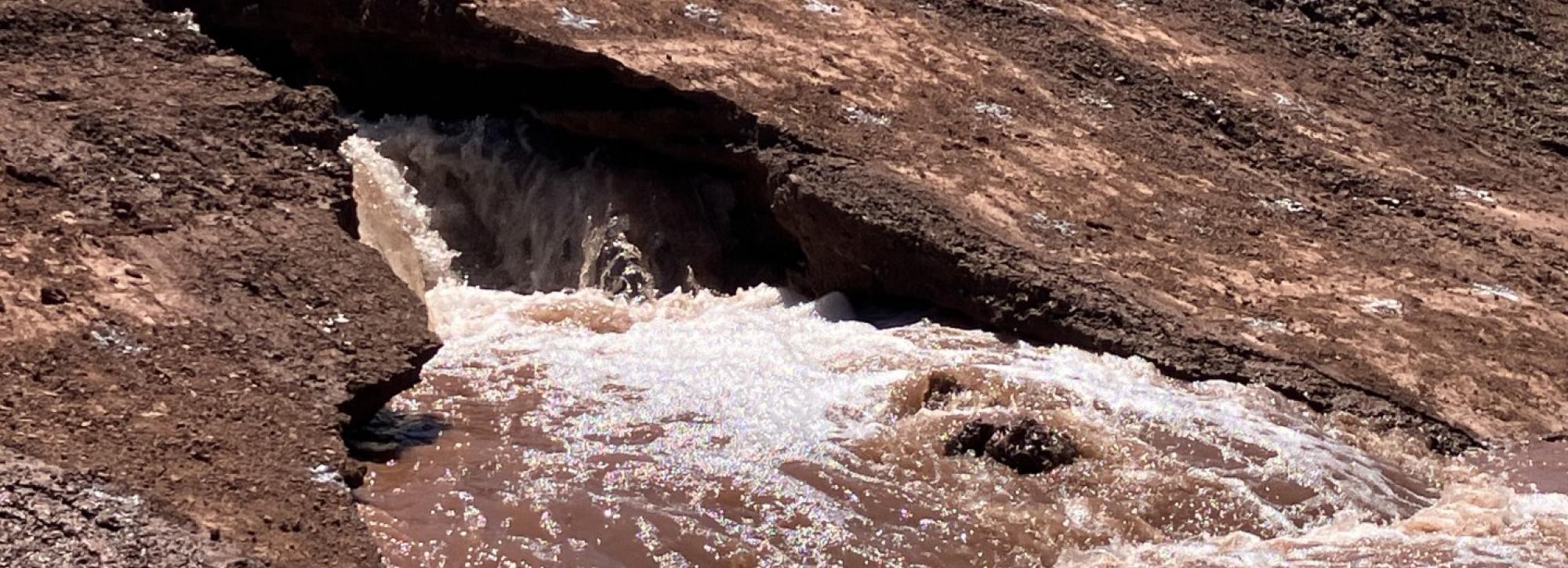
The video shows a dam breach triggered by external and head-cut erosion, but a breach triggered by internal erosion processes would lead to similar results.
Want to know more?
Contact our project lead
Craig Goff